Is Ring Size Based on Diameter or Circumference?
Is ring size based on diameter or circumference? The knowledge of such a difference may help to make measurements at home and minimize the possibility of error!
Have you ever got stuck at home measuring a ring and been confused by the millimeters, charts, and numbers of sizes? You are not alone.
Among the most frequently asked questions is the following: Is ring size based on diameter or circumference? The ring size is calculated by circumference, but in fact, diameter serves as a shortcut for measuring. Let’s find out why it is important to know the difference!
Table of Contents
Understanding How Ring Size Is Calculated
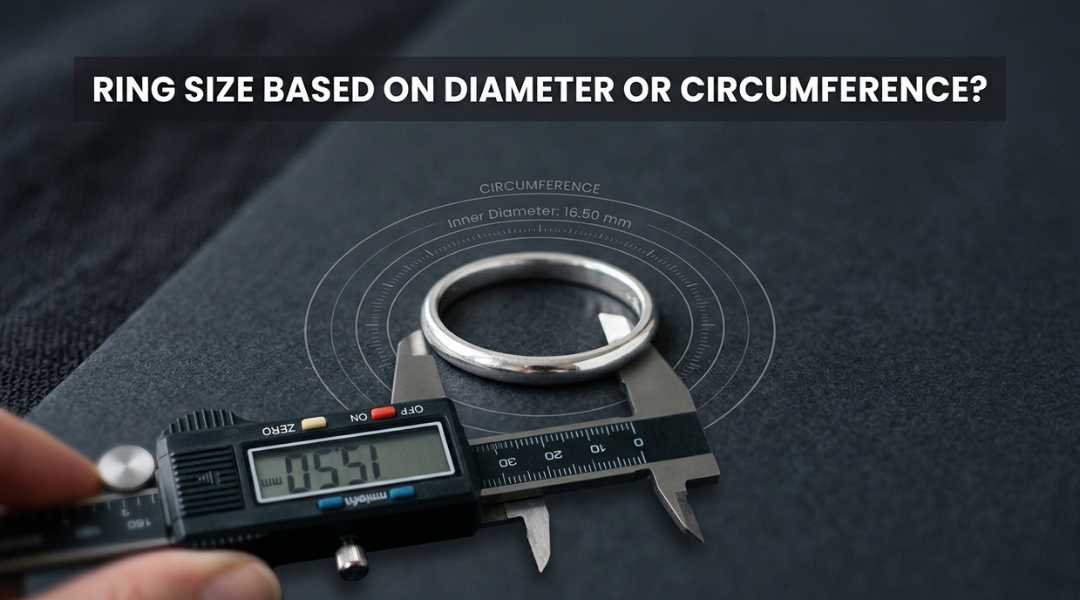
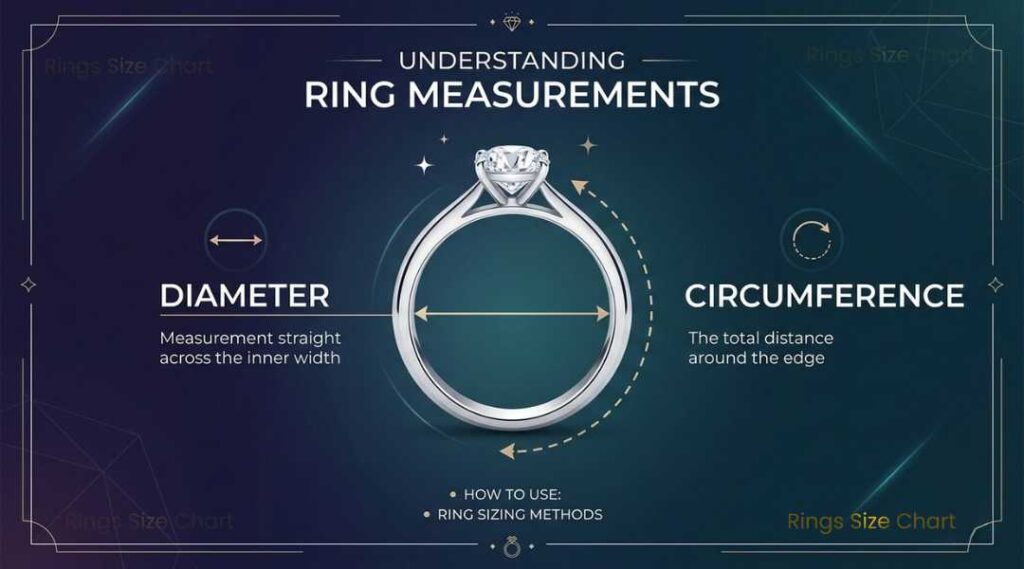
Every ring has an inner circle. That circle can be measured in two ways:
- Diameter:
the straight-line distance across the inside of the ring - Circumference:
the full distance around the inside edge
Although both measurements give the same circle, ring sizing systems are technically given on the basis of the inner circumference. In the United States, e.g. every ring size is associated with a certain inner circumference in millimeters.
Why Circumference Is the True Standard
Circumference is important because your finger is round. When a ring is fitted, it completely encloses the finger, i.e., the length around the inside of the band fixed is how to determine both comfort and security. In case the inner circumference of a ring measures the same length as your fingers, it will be suitable, This is why jewelers rely on accurate ring sizing methods. When it is too small, it will not pass over the knuckle. When it is too large, it will tumble or slip down. That is the reason why professional jewelers use circumference in determining the right ring size.
So, Why Do People Measure Diameter?
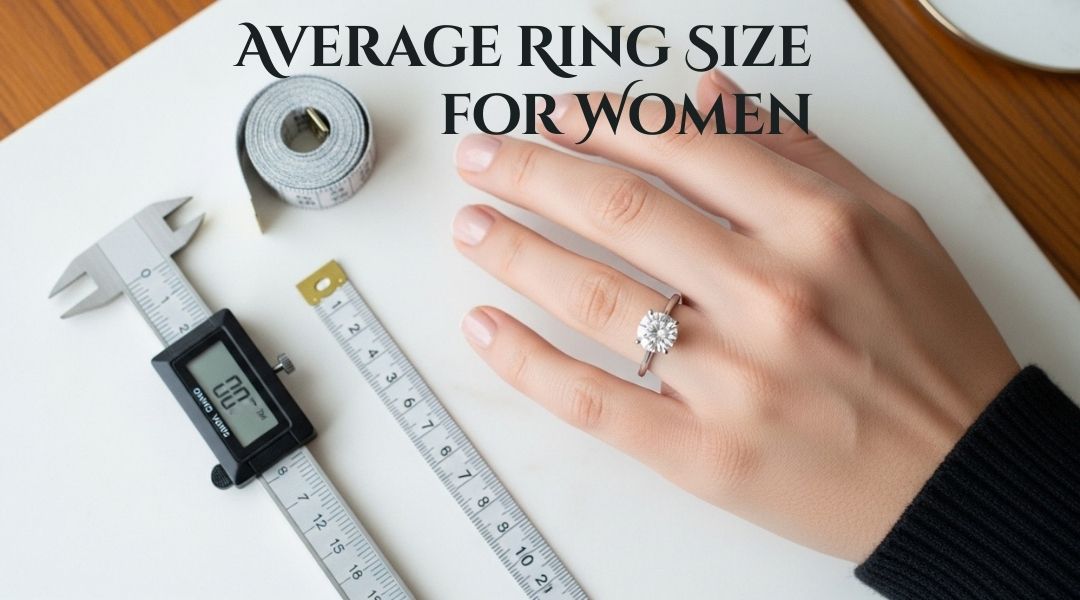
At home, the diameter is more easily measured. In case you already have a ring, but it fits well, you can follow a simple ring size measurement guide to measure it correctly using a ruler or caliper. That would provide the inner diameter in millimeters. It can be used there to derive the diameter into circumference based on a simple formula:
Circumference = Diameter × 3.14
This conversion works because all circles follow the mathematical constant π (pi). For example, if your ring measures 18 mm in diameter:
18 × 3.14 = 56.52 mm circumference
The circumference will then be considered of a given size on a sizing chart. And though circumference is used to determine sizing, diameter may be the more convenient measuring tool.
How Ring Size Charts Use Both
Most ring size charts display:
- US size number
- Inner diameter (mm)
- Inner circumference (mm)
They give them both since some individuals tend to measure their finger (circumference) and others an existing ring (diameter). An example is a US size 7, which has:
- About 17.3 mm inner diameter
- About 54.4 mm inner circumference
Both measurements represent the same size, just expressed differently.
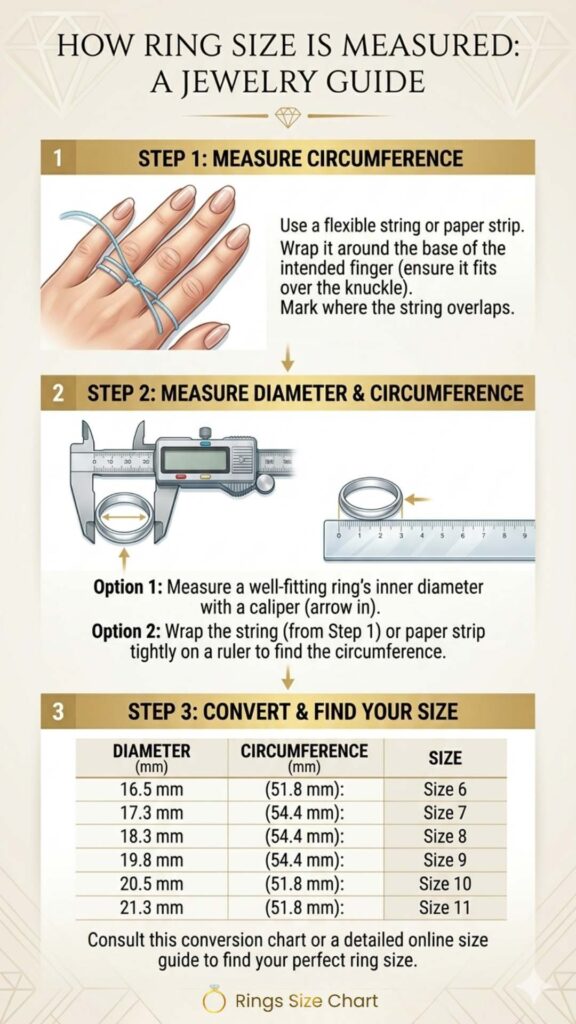
Most sizing charts show both diameter and circumference measurements so users can easily compare them. You can also use a printable ring size chart to quickly match your measurements with the correct ring size.
Measuring Your Finger vs Measuring a Ring
If you’re measuring your finger directly, you’re measuring circumference. This can be done using:
- A flexible measuring tape
- A strip of paper
- A string
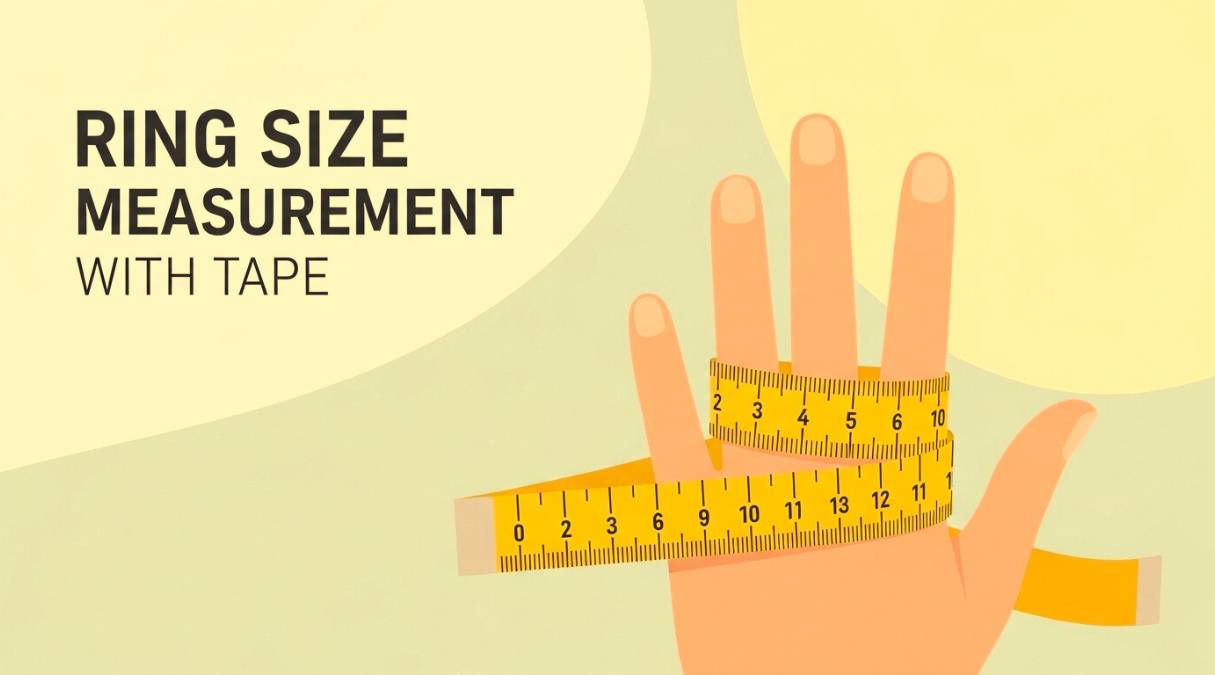
You wrap it around the base of your finger, mark the overlap point, and measure the length in millimeters. The number is a measure of circumference. When you are measuring a ring, you measure the diameter. You measure straight across the inner circle and then transform it to a circumference or compare it to a chart. The two methods are identical, with the aim being to come up with the right circumference-managed dimension.
International Ring Size Systems
Different countries use different systems:
- US and Canada use numerical sizing (6, 7, 8, etc.)
- UK uses letter sizing (L, M, N, etc.)
- In Europe, circumference is often measured directly in millimeters.
A size of 54 in Europe is literally 54 mm internal circumference. That is why the European system is the most circumference-based one.
The Final Answer
So, is ring size based on diameter or circumference? Ring size is officially determined by inner circumference. Circumference can always be confirmed or calculated through the diameter. When jewelers go up a ring size, they are assuring you that the total of the distance around the inside of the band will be correct for your finger. Diameter only assists them in getting there.
The knowledge of such a difference may help to make measurements at home and minimize the possibility of having to order the wrong size. Because with rings, any perceived fraction of a millimeter could spell the difference between falling off and perfectly fitting, it is necessary to be very precise.

Zara Fatima is a fashion writer with a love for exploring trends and styles. She enjoys researching fashion and sharing her insights to help others discover and enjoy unique pieces. Zara also loves creating dough jewelry, turning her passion into beautiful, wearable art.